Abstract
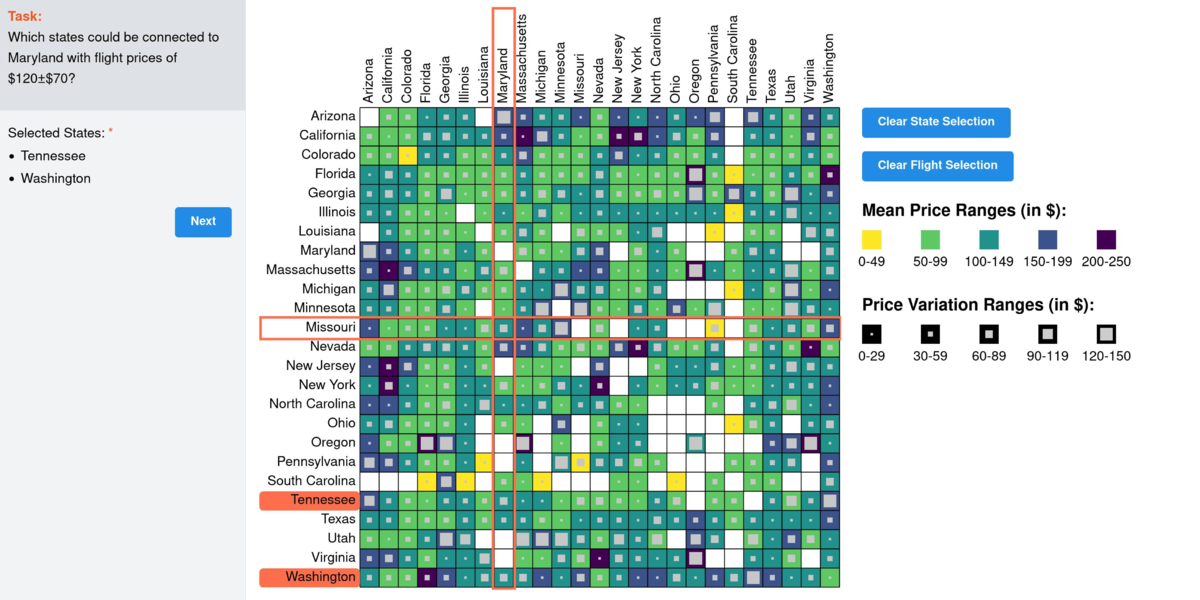
We present the first empirical evaluation of techniques for encoding distributions of quantitative edge values within adjacency matrices. In many real-world networks, edges represent not a single value but a set of measurements. While adjacency matrices preserve structural clarity, their compact cells limit the simultaneous display of multiple values. To address this, we explore edge encodings that represent distributions by two values: a measure of central tendency (mean, median, mode) and a measure of dispersion (standard deviation, variance, IQR). We select four possible encodings for evaluation that prior work has suggested are suitable for the limited space available in matrices: a bivariate color palette, embedded bar charts, and two overlaid-mark designs mapping the primary attribute to color and the secondary attribute to area or angle. In a preregistered crowdsourced study with 156 participants, we assessed performance of these encodings across eight analytical tasks and collected readability and aesthetic ratings. Results reveal clear performance regimes: area-based overlaid marks and bar charts achieved the highest overall performance; angle-based marks show moderate but less stable performance, and bivariate color consistently underperforms these alternatives. These findings clarify how visual channels behave under strict constraints and delineate the strengths and limitations of key design choices for multivariate edge visualization.Citation
Jorge Acosta,
Alexander Lex,
Tingying He
Evaluating Encodings for Bivariate Edges in Adjacency Matrices
Computer Graphics Forum (EuroVis), 45(3): e70475, doi:10.1111/cgf.70475, 2026.
BibTeX
@article{2026_eurovis_evaluating-bvnv,
  title = {Evaluating Encodings for Bivariate Edges in Adjacency Matrices},
  author = {Jorge Acosta and Alexander Lex and Tingying He},
  journal = {Computer Graphics Forum (EuroVis)},
  doi = {10.1111/cgf.70475},
  volume = {45},
  number = {3},
  pages = {e70475},
  year = {2026}
}
Acknowledgements
We gratefully acknowledge funding by the Programa Propio de Investigación,Innovación y Doctorado of the Universidad Politécnica de Madrid (UPM) and the National Science Foundation (CNS 2213756).